-1.png?width=1200&height=350&name=Logo-HiSET-RGB%20(2)-1.png "Logo-HiSET-RGB (2)-1")

HiSET Adult Educator & Advocate Resource Hub
Welcome HiSET Adult Educators and Advocates!
The HiSET Educator and Advocate Resource Hub is designed to support teachers and adult education advocates in helping test takers succeed on their path to earning a high school equivalency credential. This resource hub provides essential tools, strategies, and insights to guide students through the HiSET exam process, from preparation to testing and beyond.
Inside, you'll find testing policies, helpful resources, and key information about the HiSET exam—all tailored to make your job easier while empowering learners to reach their goals. Whether you're new to HiSET or an experienced educator or advocate, this resource hub serves as your go-to guide for ensuring test takers have the knowledge and confidence to succeed.
Establishing HiSET's Credibility
The High School Equivalency Test (HiSET) was introduced in 2014, offering a more accessible and affordable pathway for individuals seeking a high school equivalency credential. Developed by ETS (Educational Testing Service) and administered by PSI, HiSET was designed in response to changes in the high school equivalency landscape, particularly when the GED® test transitioned to a computer-only format and increased in cost.
The purpose of the HiSET® is to certify a test taker's attainment of academic knowledge and skills equivalent to those of a high school graduate. HiSET scores will identify those test takers who have performed at a level consistent with high school equivalency.
Why HiSET
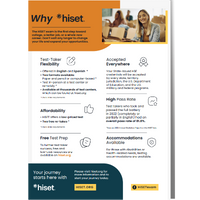
HiSET is a flexible option for individuals seeking to earn their high school equivalency credential. HiSET provides choices such as:
- Computer-based or paper-based testing.
- The ability to test at a test center or at home.
- The option to take the test in English or Spanish.
These choices extend to each subtest, allowing test takers to customize how they approach different subjects, offering a personalized testing experience.
Please note: Availability of these options may vary by state. Be sure to check your state’s specific requirements before scheduling your test.
HiSET has a range of accommodations, making it an excellent choice for non-traditional learners, individuals with any form of neurodiversity, or anyone who may need customized support to succeed. Additionally, the accommodations process is designed to benefit both students and adult educators. As an adult educator, you are allowed to submit accommodations requests on behalf of your test takers.
For full details on HiSET accommodations, please review the HiSET ADA Accommodations Policy and Process.
If you teach one high school equivalency (HSE) exam, you can teach the HiSET exam, too! All HSE exams assess the same core subject areas—Language Arts (Reading and Writing), Mathematics, Science, and Social Studies—to measure whether a test taker has the knowledge and skills equivalent to a high school graduate.
While the format and question types may vary between exams, the fundamental content remains the same. That means the teaching strategies, instructional materials, and subject knowledge you use for one HSE exam are just as effective for HiSET.
By focusing on the essential skills needed for high school equivalency, you can confidently prepare students for success, no matter which exam they take.
The HiSET Exam Subtests
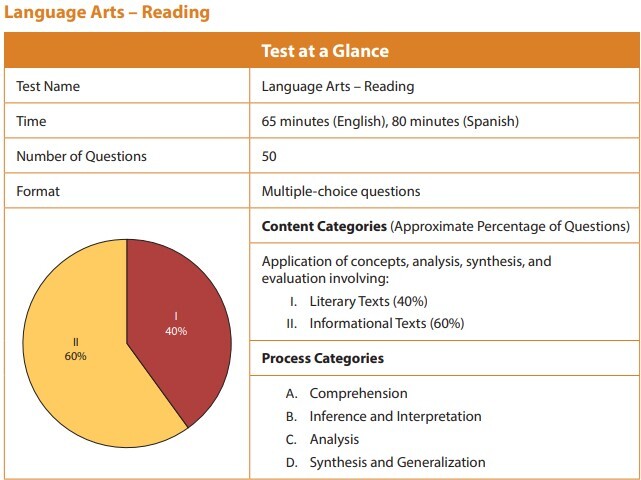
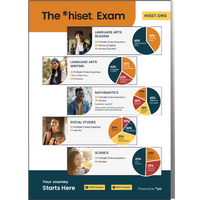
The Language Arts – Reading test provides evidence of a test taker's ability to understand, comprehend, interpret, and analyze a variety of reading material. The Language Arts – Reading test forms will include 40 percent of texts that are literary and 60 percent of texts that are informational.
In the HiSET program, test takers will be required to read a broad range of high-quality literary and informational texts. The selections are presented in multiple genres on subject matter that varies in purpose and style. The selections will span various forms (e.g., narratives, memoirs, essays, biographical sketches, editorials, and poetry). The texts generally range in length from approximately 400 to 600 words; however, the length typically increases after Spanish translation. This test may contain some questions that will not count toward the test taker’s score.
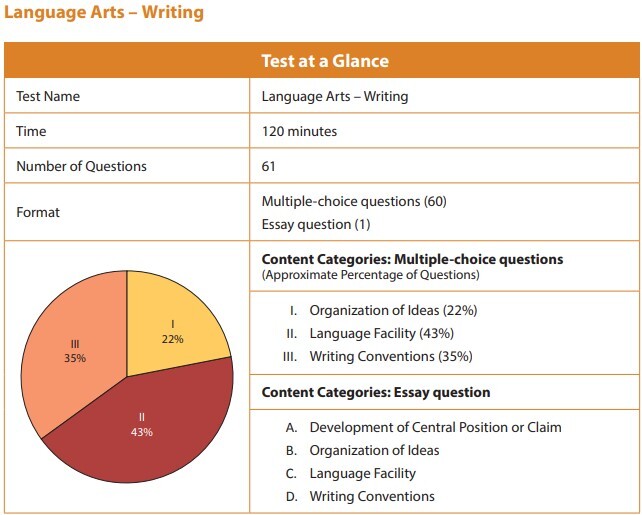
The Language Arts – Writing test provides information about a test taker’s skill in recognizing and producing effective standard American written English. The multiple-choice questions measure a test taker's ability to edit and revise written text. The essay question measures a test taker's ability to generate and organize ideas in writing.
The multiple-choice questions require test takers to make revision choices concerning organization, diction, and clarity, sentence structure, usage, and mechanics. The test questions are embedded in complete texts, which span various forms (e.g., letters, essays, newspaper articles, personal accounts, and reports). This test may contain some questions that will not count toward the test taker’s score.
The texts are presented as drafts in which parts have been underlined or highlighted to indicate a possible need for revision. Questions present alternatives that may correct or improve the indicated portions.
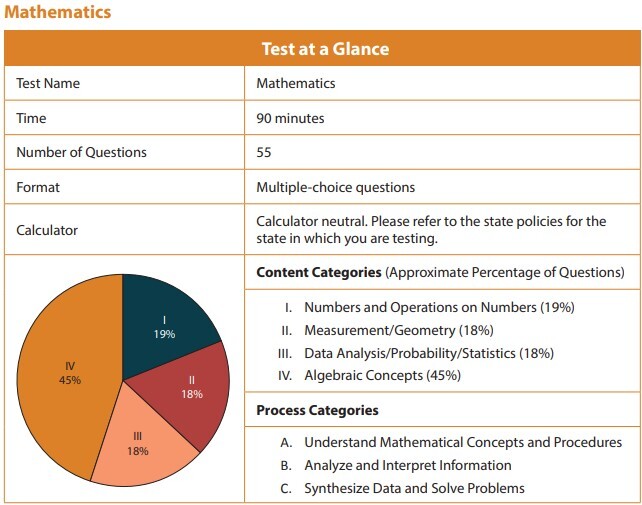
The Mathematics test assesses mathematical knowledge and competencies. The test measures a test taker's ability to solve quantitative problems using fundamental concepts and reasoning skills. The questions present practical problems that require numerical operations, measurement, estimation, data interpretation, and logical thinking. Problems are based on realistic situations and may test abstract concepts such as algebraic patterns, precision in measurement, and probability. This test may contain some questions that will not count toward the test taker’s score.
The Mathematics test is calculator neutral. A calculator is not required, but if a test taker requests a calculator, the test center is required to provide access to one of the following: four-function or scientific calculator. Please refer to the state policies for your state. Some states have specified calculator type/model requirements. A test taker may not bring their own calculator to the testing center for use on the HiSET test.
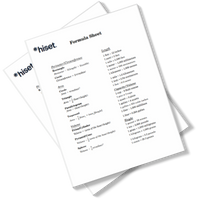
Some test questions require the use of formulas. The formulas needed to answer certain questions will be provided via a formula sheet. Test takers should know some formulas prior to testing. Some of these include: distance-rate-time, Pythagorean Theorem, and quadratic formula.
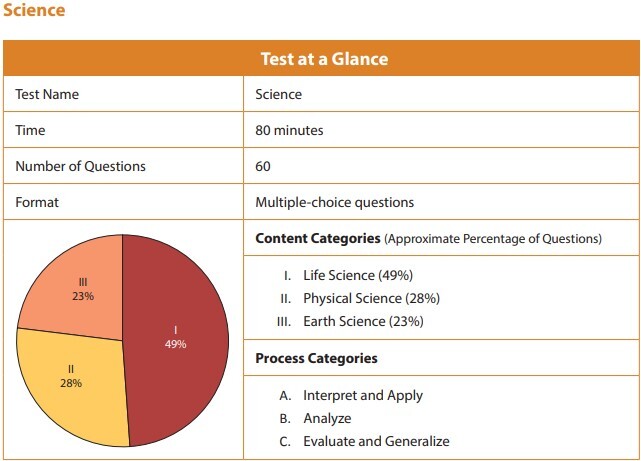
The Science test provides evidence of a test taker's ability to use science content knowledge, apply principles of scientific inquiry, and interpret and evaluate scientific information. Most of the questions in the test are associated with stimulus materials that provide descriptions of scientific investigations and their results. Scientific information is based on reports that might be found in scientific journals. Graphs, tables, and charts are used to present information and results.
The science situations use material from a variety of content areas such as: physics, chemistry, botany, zoology, health, and astronomy. The questions may ask test takers to identify the research question of interest, select the best design for a specific research question, and recognize conclusions that can be drawn from results. Test takers also may be asked to evaluate the adequacy of procedures and distinguish among hypotheses, assumptions, and observations. This test may contain some questions that will not count
.png?width=641&height=489&name=ss%20taag%20ss%20(1).png)
The Social Studies test provides evidence of a test taker's ability to use social studies content knowledge as well as analyze and evaluate various kinds of social studies information. The test uses materials from a variety of content areas, including history, political science, geography, and economics. Primary documents, posters, cartoons, timelines, maps, graphs, tables, charts, and reading passages may be used to present information. The questions may ask test takers to distinguish statements of fact from opinion; recognize the limitations of procedures and methods; and make judgments about the reliability of sources, the validity of inferences and conclusions, and the adequacy of information for drawing conclusions. This test may contain some questions that will not count toward the test taker’s score
Instructional Resources and Classroom Support
Ensuring your students are prepared for the HiSET exam is key to their success. This section provides guidance on evaluating their readiness and identifying areas where additional support may be needed.
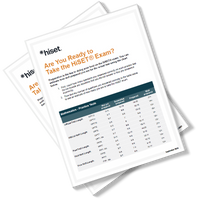
The HiSET Practice Test Results: Are You Ready? document serves as a valuable tool in this process. It correlates directly with each HiSET practice test and helps educators assess whether students have the knowledge and skills required to pass the official exam. By using this guide, you can:
- Interpret practice test scores to gauge student readiness.
- Identify subject areas where students may need further review.
- Provide targeted support to strengthen their understanding.
We encourage you to have your students take a HiSET practice test and use the Are You Ready? document to analyze their results. This will help ensure they enter the exam with confidence and the best chance of success.
All of the subtests contain multiple-choice questions. Answer choices are provided to help the test taker focus their thinking about the question. Encourage your students to make sure when answering a question that they understand what response is required.
NOTE: When taking the computer-based test, test takers can skip questions that they might have difficulty answering. The testing software has a “mark and review” feature that allows them to mark questions they want to come back to during the time they’re working on that section. The testing software also:
- Let’s test takers view a complete list of all the questions in the section on which they’re working.
- Indicates whether they’ve answered each question.
- Identifies the questions they’ve marked for review.
Additionally, they can review questions they’ve already answered and change their answers as long as they still have time remaining to work on that section.
Coach your test takers to watch out for multiple-choice questions containing “NOT,” “LEAST,” and “EXCEPT.” This type of question asks them to select the choice that does not fit. They must be very careful because it is easy to forget that they are selecting the negative. This question type is used in situations which there are several good solutions or ways to approach something, but also a clearly wrong way.
Only the Language Arts – Writing subtest contains an essay question. Remind your test takers that while working on their essay, they should remember to budget their time. They need to allow sufficient time to think about the question, plan a response and write their essay. Although the raters scoring the essays understand the time constraints and consider that when scoring the response, your students will still want to produce the best possible example of their writing. Suggest they keep these things in mind when writing their response:
- Answer the question accurately. Analyze what each part of the question is asking you to do. If the question asks you to describe or discuss, you should provide more than just a list.
- Answer the question completely. If a question asks you to do three distinct things in your response, you should cover all three things for the best score. Otherwise, no matter how well you write, you will not be awarded full credit.
- Answer the question that is asked. Do not change the question or challenge the basis of the question. You will receive no credit or a low score if you answer another question or if you state, for example, that there is no possible answer.
- Give a thorough and detailed response. You must demonstrate that you have a thorough understanding of the subject matter. However, your response should be straightforward and not filled with unnecessary information.
- Reread your response. Check that you have written what you thought you wrote. Be sure not to leave sentences unfinished or omit clarifying information.
It is good advice to save a few minutes at the end of the test to check for obvious errors. Although occasional typographical, spelling or grammatical errors will not affect the score, severe and persistent errors will detract from the overall effectiveness of the writing and lower the score.
When answering questions about graphs, tables or reading passages, test takers should provide only the information that the questions ask for. In the case of a map or graph, it is recommended to read the questions first and then look at the map or graph. In the case of a long reading passage, it is recommended to go ahead and read the passage first, noting places they think are important on their scratch paper, and then answer the questions. Again, the most important thing is to be sure they answer the questions as they refer to the material presented. Coach your students to read the questions carefully.
Set your students up for success by simulating the real HiSET testing experience with free computer-based practice tests. These practice tests are similar to the look, feel, and functionality of the actual exam, helping test takers get comfortable with the test format, navigation, and timing before test day.
By practicing in a real test-like environment, students can build confidence, reduce test-day anxiety, and improve their performance before they sit for the official exam. Encourage your students to take advantage of this valuable tool to ensure they’re fully prepared when it matters most.
Scoring
View the full list of resources here
Ensuring your students are prepared for the HiSET exam is key to their success. This section provides guidance on evaluating their readiness and identifying areas where additional support may be needed.
The HiSET Practice Test Results: Are You Ready? document serves as a valuable tool in this process. It correlates directly with each HiSET practice test and helps educators assess whether students have the knowledge and skills required to pass the official exam. By using this guide, you can:
- Interpret practice test scores to gauge student readiness.
- Identify subject areas where students may need further review.
- Provide targeted support to strengthen their understanding.
We encourage you to have your students take a HiSET practice test and use the Are You Ready? document to analyze their results. This will help ensure they enter the exam with confidence and the best chance of success.
Each of the five subtests in the HiSET battery is scored on a scale of 1–20. To pass, a test taker must do all three of the following:
- Achieve a score of at least 8 on each of the five individual subtests*
- Score at least 2 out of 6 on the essay portion of the writing test
- Have a total combined score on all five tests of at least 45
The total score of 8 and essay score of 2 must be earned on the same test date. Scores from multiple tests cannot be combined.
*Note: Some states and jurisdictions may set passing scores that are higher, but under no circumstances can a test taker pass with a total score lower than 45 on the full battery of tests.
The individual test score report also indicates whether a test taker has achieved the score required to demonstrate college and career readiness — with at least 15 out of 20 on any of the subtests. For the language arts–writing test, they must score at least a total score of 15 with a score of 4 on the essay.
Test Center and Test Scheduling Information
Registration, scheduling, ID policies, and retake options vary by state. Please refer to your state’s specific requirements for details on:
- How and Where Students Can Register
- Test Scheduling Options
- ID Requirements and Test Security Policies
- Retake Policy
Practice Test Materials
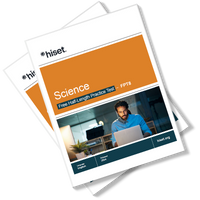
Science Free Practice Tests
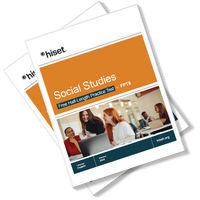
Social Studies Free Practice Tests
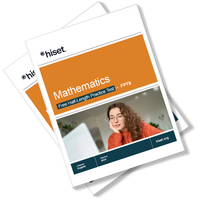
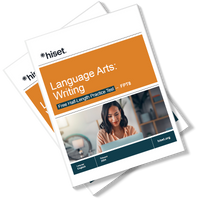
Language Arts - Writing Free Practice Tests


.png?width=200&name=ed%20and%20career%20pathways%20(1).png "ed and career pathways (1)")